
This article explains how Alvys routes load data to QuickBooks Online, how customers and vendors are matched or created automatically during export, how to manually export transactions, and the steps to modify or revert a transaction that has already been exported.
Overview
When a load is processed for billing in Alvys, the integration creates or updates invoices and bills in QuickBooks Online (QBO) based on the load’s billing configuration. This article explains the full export workflow: how Alvys determines who to invoice or pay in QBO, how customers and vendors are matched (linked or auto-created), how to push transactions manually or review the export queue, and what to do when an exported transaction needs to be changed or reversed.Before You Start
Before exporting transactions:- Confirm the QuickBooks Online integration is connected and account mappings are configured.
- Confirm loads are released to billing before attempting to export invoices.
- You need the “CompanyProfileManager” permission to access the Integrations export queue and re-export transactions. This permission is available to users with the Admin, Partner Admin, or Support role. Dispatchers and accounting staff who can access the Transactions tab on individual loads may also initiate exports from the load detail page.
Subsidiary Determination for Transaction Exports
When setting up the QBO integration, the user normally selects which subsidiary QBO accounts to connect. This section explains which connected QBO account will receive the exported invoices and/or bills.Customer Invoices and Invoice As field
The Invoice As field represents the billing subsidiary responsible for issuing the customer invoice. This determines the legal entity name that appears on the invoice. All Accounts Receivable (AR) transactions are exported to the QBO subscription tied to this subsidiary. Example: If a load’s Invoice As field is set to Alvys Brokerage, the invoice exports to the QuickBooks subscription linked to Alvys Brokerage.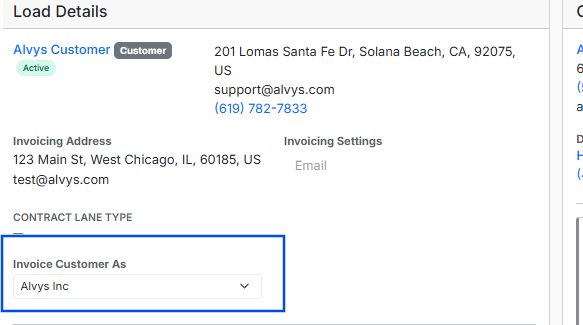 Features the customer load details page with a blue outline focusing on the Invoice Customer As configuration dropdown set to “Alvys Inc”.
Carrier Bills and Tender As field
The Tender As field identifies the subsidiary responsible for dispatching the load and paying the carrier. It also determines the trip type:- If the selected subsidiary is a broker, the trip type is set to Brokerage.
- If the selected subsidiary is a carrier, the trip type is set to Carrier.
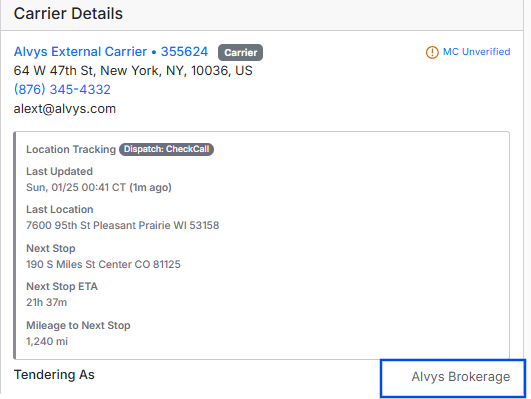 Shows carrier details with a blue box at the bottom highlighting that the load is being Tendered As Alvys Brokerage.
Dual Authority Carriers
For carriers with dual authority, operational mode is automatically set based on the Tender As subsidiary. Users can manually update operational mode to Carrier or Broker, which may affect QBO exports. Displays a minimal status view of the Operational Mode field showing a blue badge marked as CARRIER.
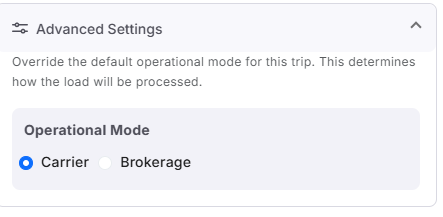 Shows the operational advanced settings module with the Operational Mode radio button set specifically to Carrier.
Driver Bills and Driver Subsidiary Field
Each driver profile has a Subsidiary field representing the subsidiary the driver is tied to. When generating driver statements, the QuickBooks subscription receiving the bill depends on the driver’s subsidiary. Shows a driver’s employment summary card with a blue box emphasizing its assigned corporate Subsidiary as Alvys Inc.
Customer Linkage, Creation, and Accounting Fields used for QBO
This section describes how Alvys identifies and links customers and brokers in QuickBooks Online (QBO), how new customer records are created when no match is found, and how key accounting fields such as customer names, invoicing details, and payment terms affect invoice exports and data synchronization.Customer External Accounting Name
The customer’s External Accounting Name is used to identify a customer or broker in QuickBooks Online (QBO). When exporting an invoice Alvys first searches for an exact match in QBO using this field.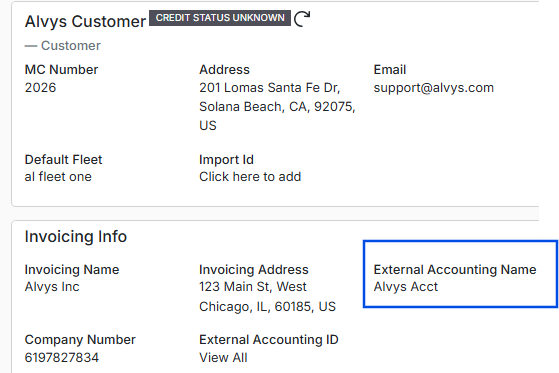 Displays customer invoicing info with a blue outline framing the configured External Accounting Name (“Alvys Acct”).
Invoicing Name (Previously Called Billing Name)
The Invoicing Name determines how the customer or broker appears on invoices generated in Alvys. It does not affect the customer record created in QBO.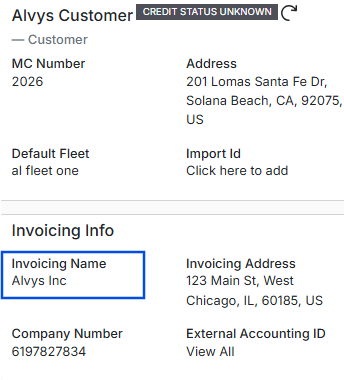 Features customer profile parameters with a blue bounding box highlighting the designated Invoicing Name (“Alvys Inc”).
- Invoicing address (mapped to the billing address in QBO)
- Customer email
- Customer phone
- Customer address (used for the shipping address in QBO)
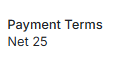 A minimal interface view displaying the customer’s billing Payment Terms configured as Net 25
Vendor Linkage, Creation, and Accounting Fields used for QBO
This section explains how Alvys links carriers and drivers to QuickBooks Online (QBO), how vendor records are created when no match is found, and which accounting fields control bill synchronization. This section explains how Alvys links carriers and drivers to QuickBooks Online (QBO), how vendor records are created when no match is found, and which accounting fields control bill synchronization.Carrier External Accounting Name
The carrier’s External Accounting Name is used to identify a vendor in QuickBooks Online (QBO). When exporting a bill, Alvys first searches for an exact match in QBO using this field.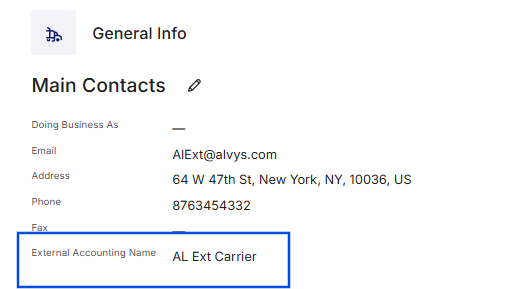 Features a carrier’s general contact card with a blue box spotlighting the assigned External Accounting Name (“AL Ext Carrier”).
Driver Name and 1099 Tax Details
Drivers, including company drivers and owner-operators, may operate as 1099 drivers. These drivers have additional tax detail fields on their profiles, such as:- Tax Company Name
- Tax Company Address
 Displays corporate Tax Information records with blue frames emphasizing the Tax Category (1099), Company Name (Alvys Company), and its Company Address.
Carrier Payment Terms
The Carrier Payment Terms field defines the agreed-upon time frame for paying a carrier. This is configured on the company profile for each subsidiary.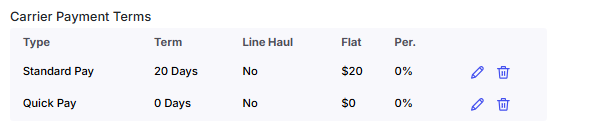 Displays the Carrier Payment Terms data table detailing standard rules for Standard Pay (20 days, $20 flat fee) and Quick Pay.
Steps
Invoice Transaction Export Demonstration
This section provides an overview of the areas within Alvys from which customer invoices can be exported from and the key validations required to ensure successful export to QuickBooks Online.Individual Load Invoice Export
Generating a customer invoice from the Load Details page triggers its export to QuickBooks Online. To ensure a successful export, all relevant configurations and data must be verified before the invoice is generated. Ensure the customer being invoiced is correct. Verify that the External Accounting Name is set correctly for the customer. If no External Accounting Name is configured, ensure the standard customer or broker name exactly matches the customer record in QuickBooks Online.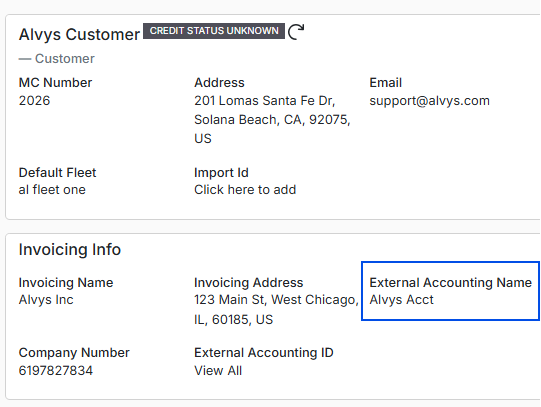 Shows a customer info layout with a blue box emphasizing the designated External Accounting Name (“Alvys Acct”).
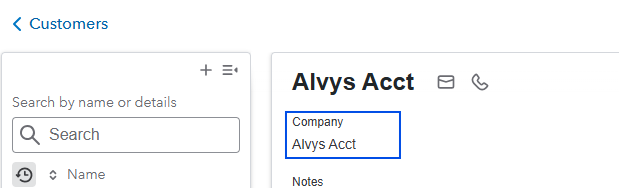 Shows the customer info layout in QBO with a blue box emphasizing the designated External Accounting Name (“Alvys Acct”).
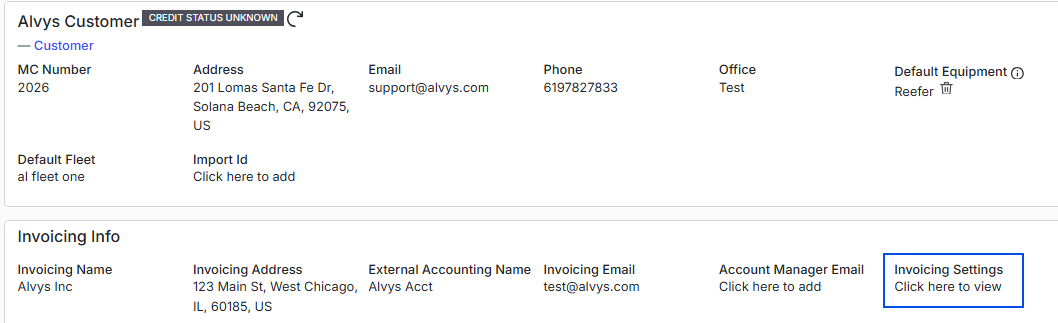 Features a customer profile with a blue box drawing attention to the Invoicing Settings action link.
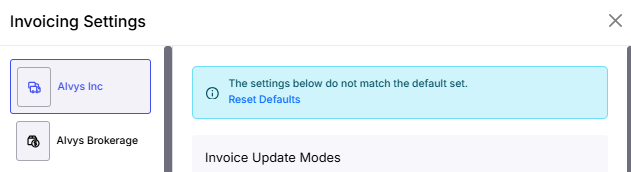 Shows the Invoicing Settings parameters modal with a blue border highlighting the chosen “Alvys Inc” profile on the side panel
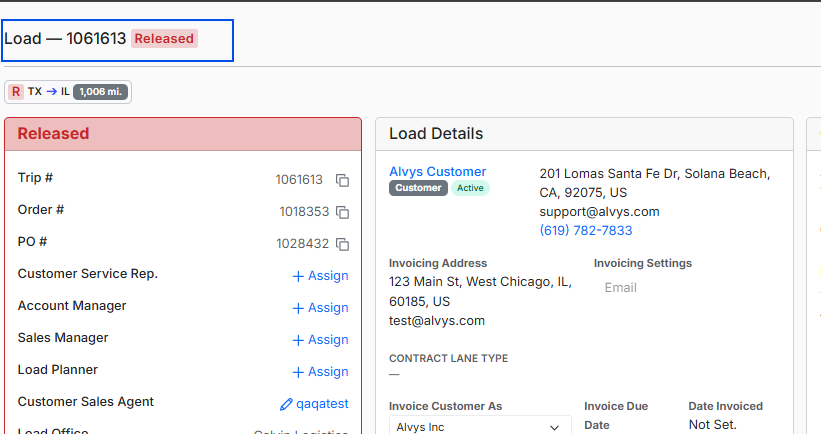 Shows the load details page with a blue bounding box highlighting the main record header for Load — 1061613 Released.
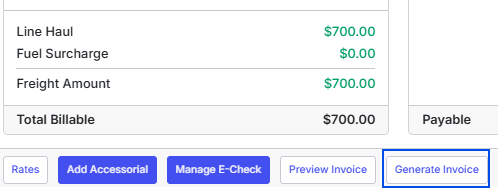 Shows the money box with a blue outline framing the Generate Invoice execution button.
 Displays the QBO transaction search bar results looking up a specific document number to find its corresponding Invoice database row.
Batch Invoice Export
The Batch Invoicing page in Alvys is located under accounting, then Invoice in the left navigation menu or directly at https://app.alvys.com/#/accounting/invoicing.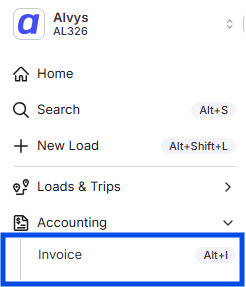 Shows the main platform sidebar navigation column with a blue box highlighting the Invoice selection item.
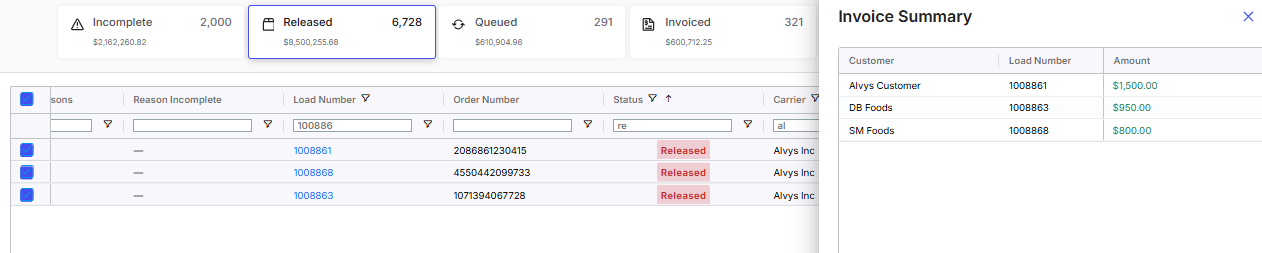 Shows the “Released” tab on the Invoicing page with an Invoice Summary panel that lists three selected customer accounts.
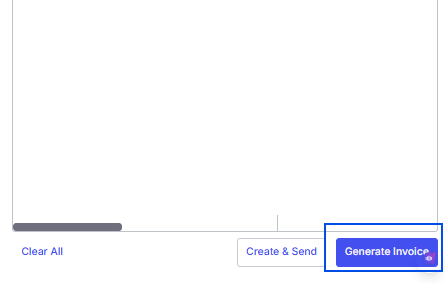 Billing execution controls with a blue box highlighting the Generate Invoice button.
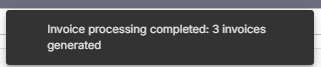 Shows a status toast notification confirming that invoice processing completed and three invoices were generated.
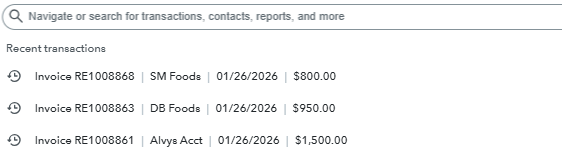 Displays a search bar dropdown tracking recent transactions for three newly created invoices dated 01/26/2026.
Summary invoice Export
Summary invoicing consolidates multiple loads for a customer into a single invoice. The Summary Invoicing page can be accessed from Accounting then Summary Invoicing. For more information on configuring customers for summary invoicing, see How to use Summary Invoicing. The invoice export is triggered when the consolidated summary invoice is generated, creating a single invoice that reflects the total amount for all loads included. Only customers configured with the summary invoice type will appear when selecting a subsidiary. Ensure that the subsidiary is correct, as this determines the QuickBooks Online company where the invoice will be sent. On the Summary Invoicing page, from the Loads Not Invoiced tab, select the loads to include and add them to a draft summary invoice. Once the draft is prepared, generating the invoice will create the summary invoice and export it to QuickBooks Online. Features the Summary invoicing, Load Not Invoiced tab with a blue box highlighting the Add to Draft option for selected un-invoiced loads.
 Shows the “Draft Invoice” staging tab with a blue outline focusing on the Generate Invoice action button.
 Displays the “All Invoices” log tracking summary invoice S1000048 in a Pending status state.
 Image showing the QBO global transaction search bar in results with a blue box framing the record for summary invoice S1000048.
Bill Transaction Export Demonstration
This section explains the different methods available in Alvys for exporting bill transactions to QuickBooks Online. It covers external carrier bills, carrier settlements, and driver bill exports, including the configuration requirements that determine when and how each bill is exported.Individual Trip External Carrier Bill Export
External carrier bills can be exported directly from individual loads based on the configured external accounting settings. The export is triggered when the customer invoice is generated. Before generating the invoice, ensure the correct external carrier is assigned to the trip. The subsidiary selected in the Tender As field must also be verified, as this subsidiary determines where the carrier bill will be sent. The selected subsidiary must be configured to receive carrier bills through the QBO integration.⚠️ For tenants operating in dual-authority mode, an additional validation is required. The operational mode must be set to Brokerage. If the operational mode is set to Carrier, the external carrier bill export will not occur.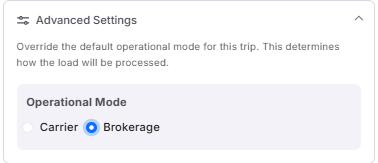 Displays the advanced configuration card with the trip’s Operational Mode radio toggle set to Brokerage.
Displays the advanced configuration card with the trip’s Operational Mode radio toggle set to Brokerage.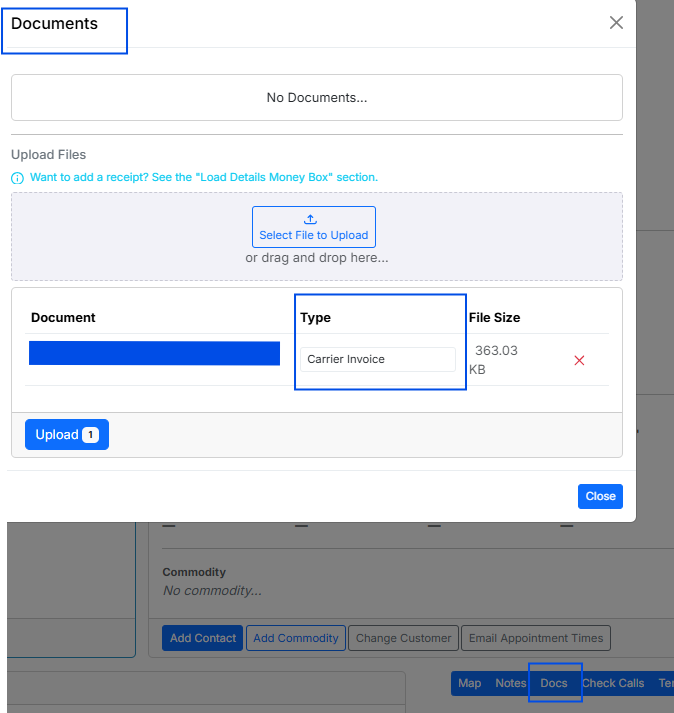 Image showing the Documents management modal with blue boxes highlighting the Docs menu tab and the Carrier Invoice file type classification dropdown.
 Shows carrier billing entries under a brokerage load with a blue frame highlighting the assigned Carrier Invoice Number (“AL202512”).
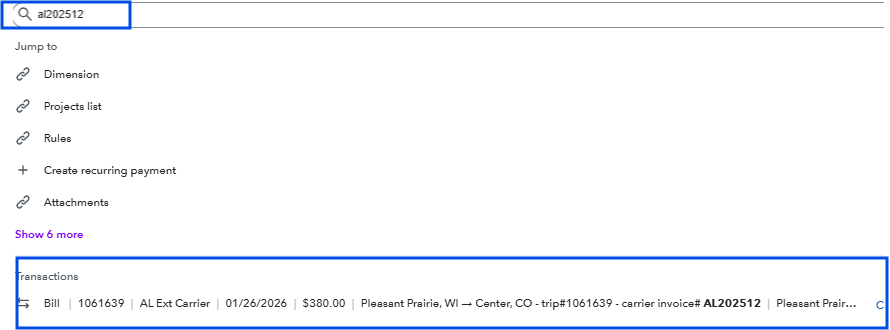 Shows global search results looking up carrier invoice “AL202512” to locate its corresponding bill transaction row in the lower panel.
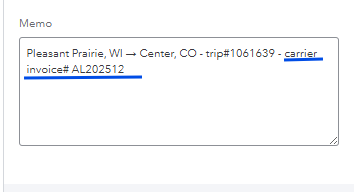 Displays a transaction Memo text box containing specific trip routing details alongside the underlined carrier invoice number.
Carrier Settlements
The Carrier Settlements module provides brokers with tools to generate transparent and accurate carrier statements and settlement bills. This page can be accessed from the accounting section of Alvys under Carrier Settlements. Additional details about this feature can be found in the Carrier Settlements Help Center Article. When carrier settlements are used, the carrier bill is exported when a carrier statement is generated. To allow this export, the Carrier Statements External Accounting setting must be enabled for the subsidiary. If this setting is not enabled, no carrier bill will be exported when the statement is generated. Shows the checked option box for enabling Carrier Statements within the configuration parameters.
💡 If a carrier bill requires modification after export, refer to the Modifications to Transactions section for guidance.
Driver Bill Export
Driver bills can be exported either from the legacy Pay Drivers page or from the newer Driver Settlements module. The export behavior depends on the configured driver billing settings. The recommended configuration is Single Bill Export. When enabled, multiple trips, deductions, and credits included in a driver statement are consolidated into a single bill and exported to QuickBooks Online. This approach is ideal for tenants operating on weekly or biweekly pay cycles. The subsidiary used for exporting driver bills is determined by the subsidiary assigned on the driver profile in Alvys.Driver Pay Page (Legacy)
For tenants still using the legacy Pay Drivers page, driver statements generated from this page may be reverted from the driver profile. Reverting a driver statement deletes the corresponding driver bill from QuickBooks Online, provided the bill remains open and no payments have been applied.Driver Settlements
Driver Settlements replaces the Pay Drivers module and introduces enhancements such as draft statements, predefined pay periods, and bulk actions. Additional details can be found in the Driver Settlements Help Center Article. For statements generated using the Driver Settlements module, reverting the statement from the Statements tab removes the associated driver bill from QuickBooks Online, as long as the bill remains open and no payments have been applied.Shared billing Walkthrough/Demonstration
Enable Shared Billing on both subsidiaries
In the QBO accounting integration setup shared billing must be enabled on both the Invoice As subsidiary and the Tender As subsidiary. Each subsidiary must also have its own QuickBooks Online integration configured. If shared billing is not enabled on both sides, intercompany transactions and carrier or vendor bills will not export correctly.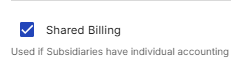 Displays the checked checkbox for enabling Shared Billing functionality across subsidiaries with individual accounting setups.
Assign different subsidiaries on the load
On the load, select:- Invoice As subsidiary – the subsidiary responsible for billing the customer.
- Tender As subsidiary – the subsidiary responsible for paying the carrier or driver.
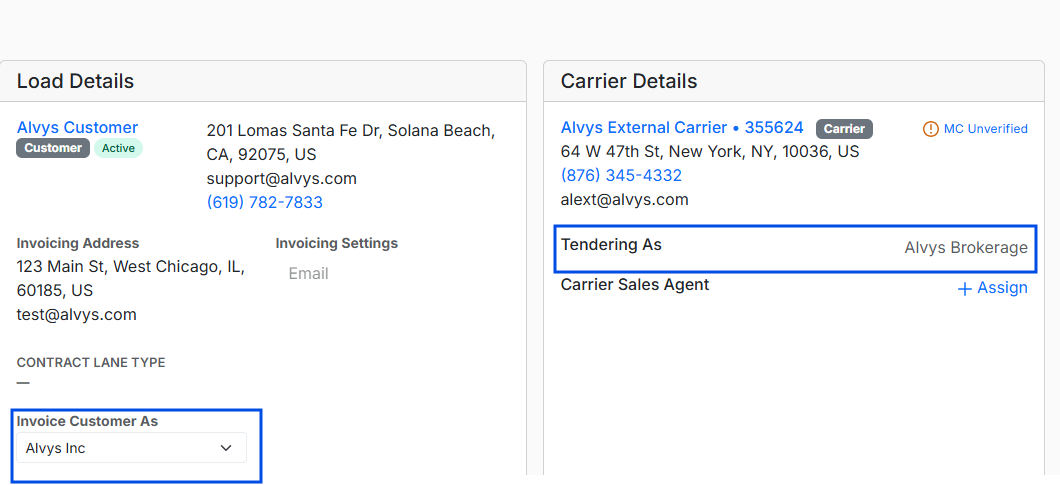 Shows load details with blue outlines highlighting the Invoice Customer As and Tendering As corporate identity fields.
Release the load
Once dispatch and financial details are complete, release the load so it becomes eligible for invoicing. Ensure all required documents are present on the load before attempting to invoice.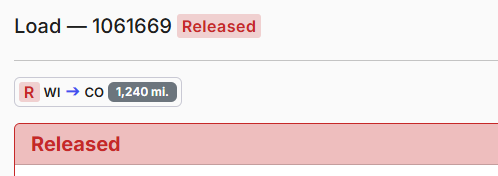 Shows the tracking summary tracking header for Load — 1061669 marked with a red Released status badge.
Generate the customer invoice
Shared billing export is triggered when the customer invoice is generated.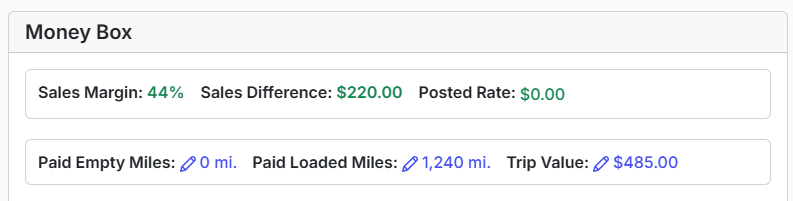 Displays the load’s financial Money Box dashboard panel tracking sales margins, mileage totals, and final trip values.
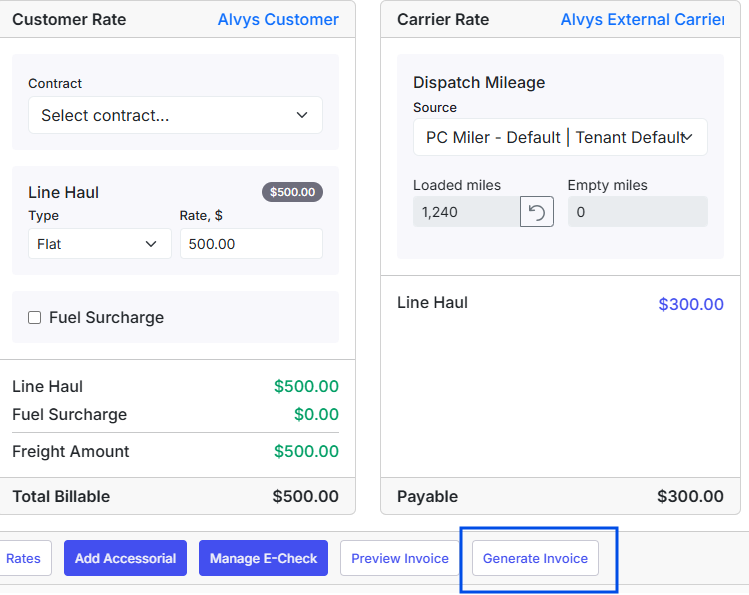 *Features side-by-side Customer and Carrier Rate columns with a blue box emphasizing the clickable Generate Invoice execution button. *
Transactions created during export
Invoice As subsidiary:- An intercompany bill is created to the Tender As subsidiary
- A customer invoice is created and exported to QuickBooks Online. Tender As subsidiary:
- A vendor bill is created for the external carrier or driver.
- An intercompany invoice is created back to the Invoice As subsidiary.
Verify transactions in QuickBooks Online
Each subsidiary will receive only the transactions applicable to its accounting company. This ensures that revenue, expenses, and intercompany balances remain accurate and properly separated. Invoice As Subsidiary e.g. Alvys Inc Displays the QBO transaction interface with a green border highlighting recent ledger records for a bill and an invoice linked to load 1061669.
 Shows the QBO recent transactions search log tracking updated bill and invoice ledger rows generated under different entities for load 1061669.
Modifying Previously Exported Transactions
Once a transaction has been exported from Alvys to QuickBooks Online (QBO), all corrections and updates must be made in Alvys and then synchronized to QBO through the regeneration process. Alvys serves as the system of record for all exported accounting transactions. Changes made directly in QBO can result in data inconsistencies and prevent updates from syncing correctly. This section explains how previously exported transactions can be modified, which changes are supported, and the conditions under which those modifications are allowed.Customer Invoices Exported from Load and Invoicing Pages
Previously exported invoices may be modified only while the invoice remains open. An invoice is considered open when a full payment has not been applied in QBO. Once a payment is fully applied and synced, the invoice becomes closed in Alvys and no further modifications are permitted. In these situations, Alvys Support must be contacted for assistance. Invoice updates are typically synchronized by regenerating the customer invoice after changes are made. However, certain fields automatically update the QBO invoice without requiring regeneration. Updates to the following load invoice fields are applied automatically to QuickBooks Online without requiring invoice regeneration: Customer linehaul amount Customer fuel surcharge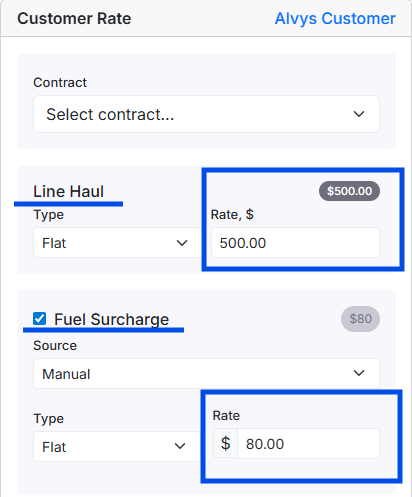 Displays a customer billing layout with blue boxes highlighting a Line Haul rate of 80.00.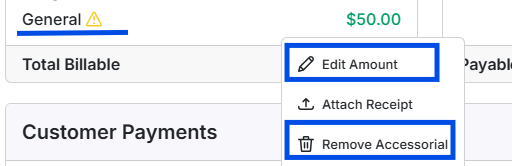
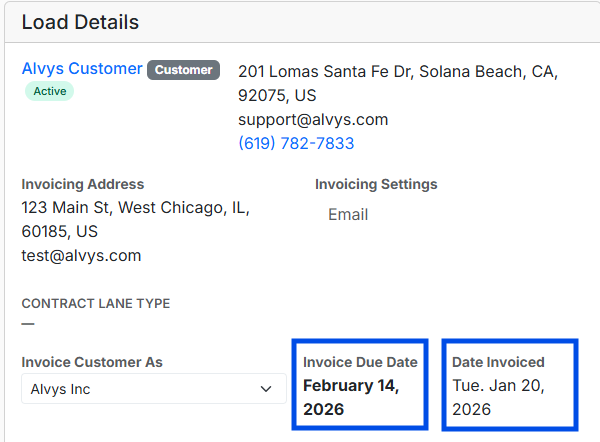 Shows a portion of the Load Details workspace with blue boxes outlining the Invoice Due Date (February 14, 2026) and the Date Invoiced (Tue. Jan 20, 2026).
Changing the Customer on a Previously Exported Invoice
The customer associated with a load can only be changed while the load is in a status prior to Invoiced (e.g., Queued). This indicates that the invoice has been generated in Alvys but has not yet been submitted to the customer. Once the invoice has been submitted, the load status updates to Invoiced based on the invoicing mode, and the customer cannot be changed directly. In this case, users must contact Alvys Support to revert the load status to queued, allowing the customer to be updated and the invoice regenerated for synchronization with QuickBooks Online.Sample QBO Invoice Exported from Alvys
The customer’s name displayed on the exported invoice reflects the External Accounting Name.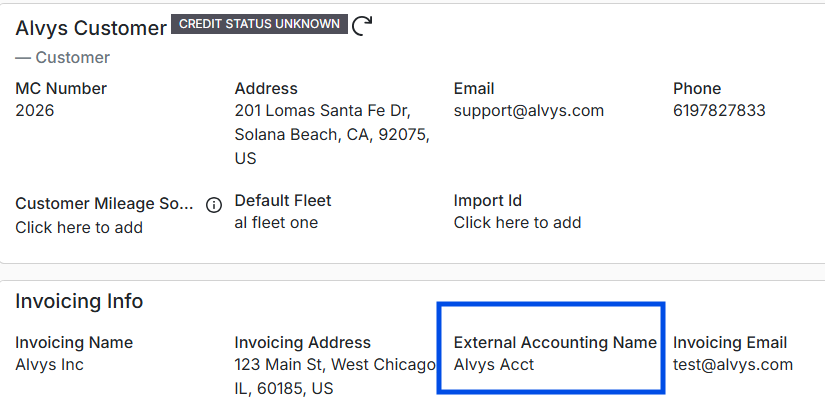 Displays a customer account profile window with a blue box emphasizing the designated External Accounting Name (“Alvys Acct”).
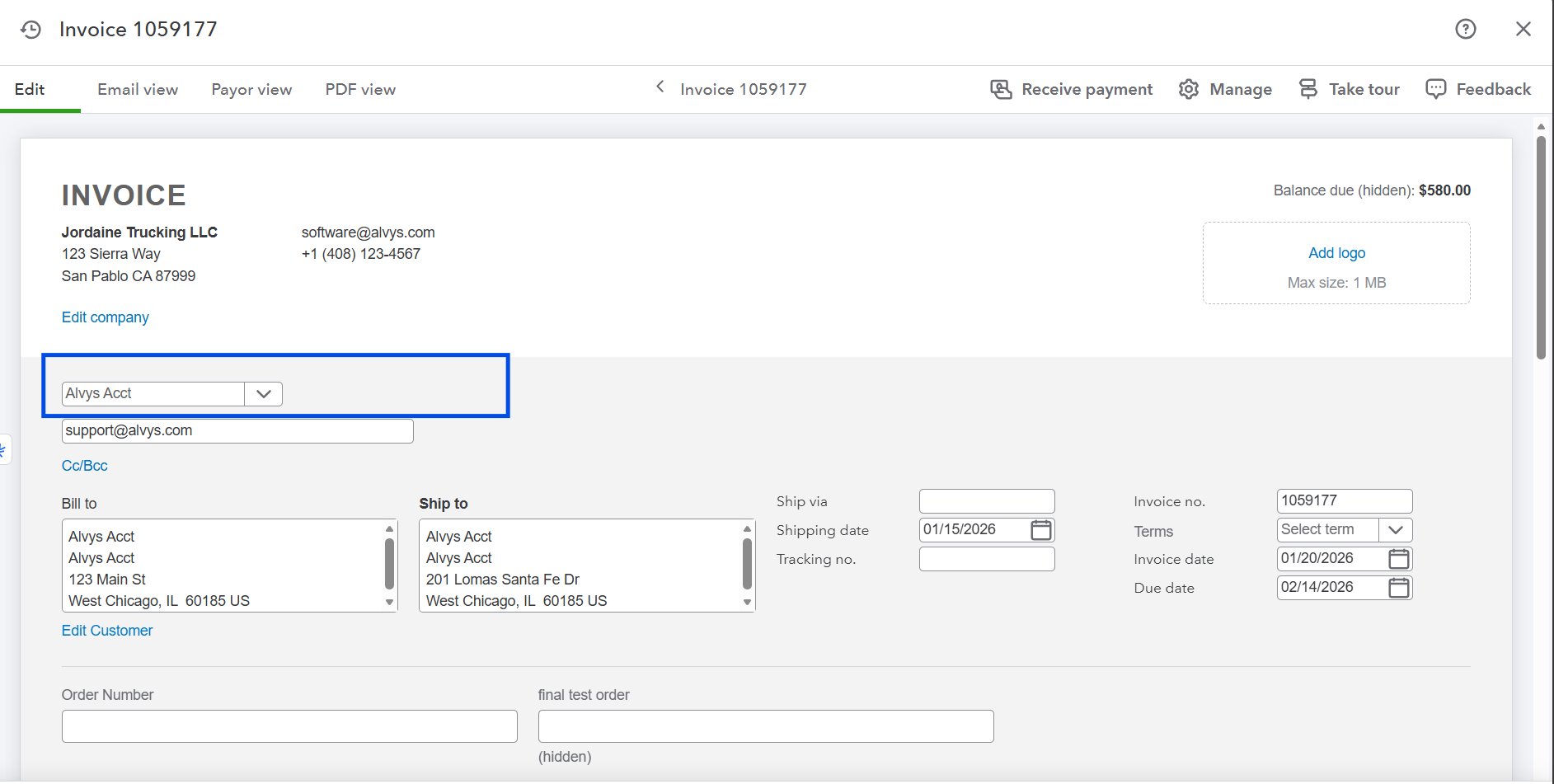 Features a comprehensive document view for Invoice 1059177, with a blue outline focusing on the main client account selection dropdown menu (“Alvys Acct”).
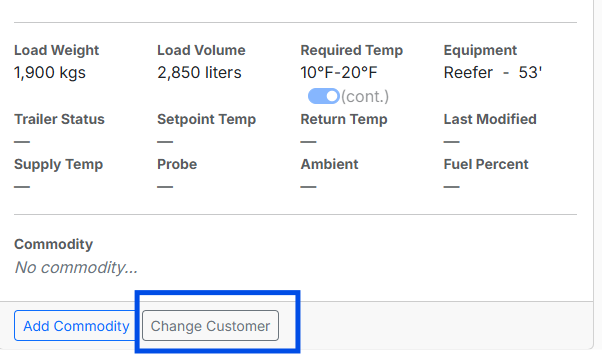 Shows a load tracking card focusing on load parameters, with a blue box highlighting the clickable Change Customer button at the bottom.
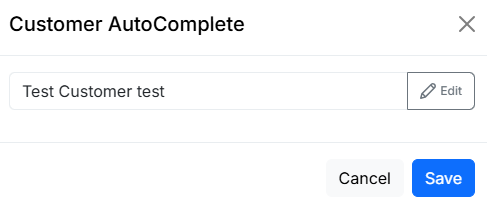 Displays a Customer AutoComplete input dialog panel, providing a text field to edit or save “Test Customer test”.
 Features financial workflow option controls with a blue box calling attention to the Regenerate Invoice action button.
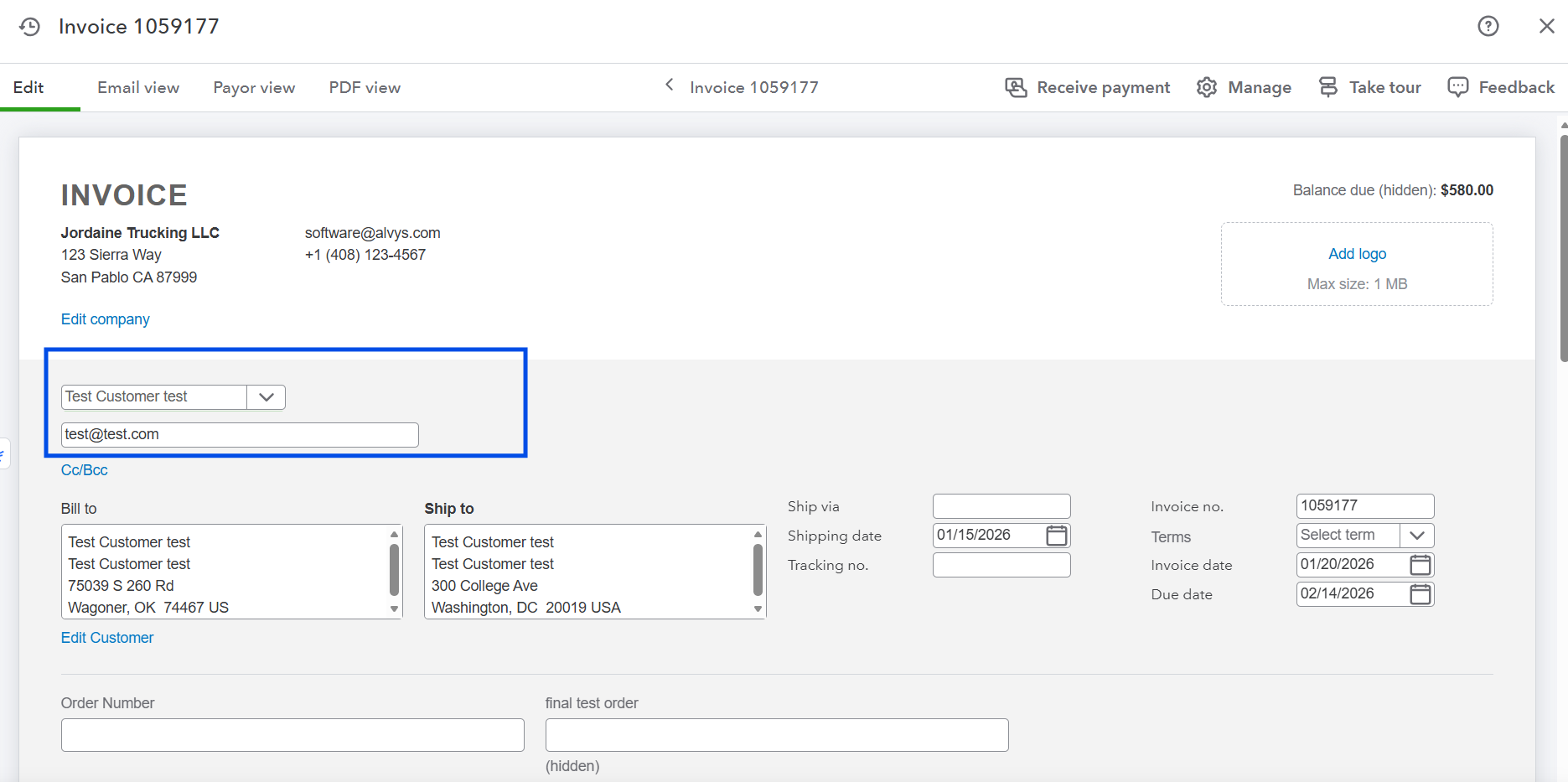 Shows the updated invoice view for document 1059177, highlighting the blue dropdown box that reflects the new buyer profile name (“Test Customer test”).
Updating Invoice Customer Fields
Fields such as invoicing address, shipping address, customer email, and customer phone are managed in the customer profile. Steps to update customer fields:- Navigate to the customer profile in Alvys.
- Apply the necessary changes.
- Save the updates.
- Regenerate the invoice.
- Refresh or reopen the invoice in QBO to view the changes.
Updating the Invoice-As Subsidiary After Invoice Export
Changing the Invoice-As subsidiary and regenerating the invoice will automatically remove the original invoice that was already exported to the connected QBO subsidiary. However, to prevent duplicates, ensure that the original invoice is removed; if not, manually delete it after exporting the updated invoice. Steps to update the Invoice-As Subsidiary: In the Load Details section, click the Invoice Customer As dropdown.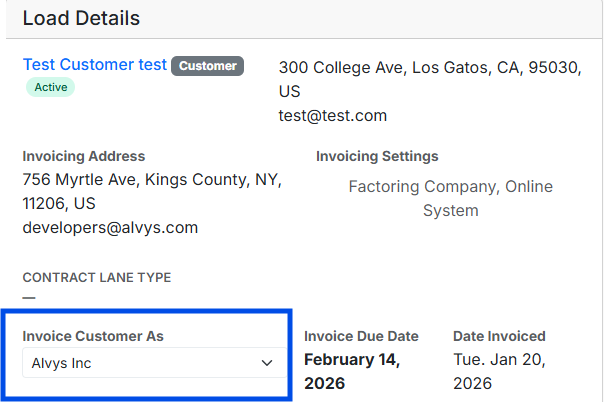 Displays the revised Load Details form showing a highlighted blue box around the Invoice Customer As selection dropdown menu.
- Select the correct subsidiary to assign to the load.
- Save the changes.
- Regenerate the invoice in Alvys.
- Verify in the subsidiary’s QBO account that the new invoice has been successfully exported.
- Delete the original invoice in QBO to avoid duplicates.
Customer Payment terms
Alvys does not set customer payment terms on exported invoices. Instead, the payment terms configured on the customer profile are used to calculate the invoice due date.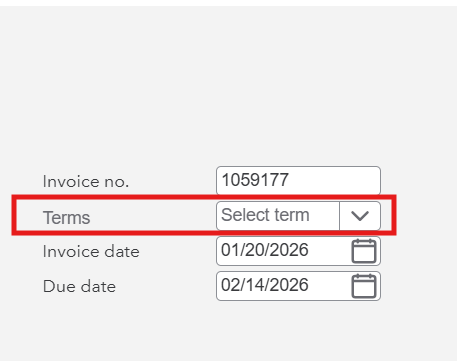 Shows a QBO invoice with a red box emphasizing the Terms dropdown row.
Modifications to Summary Invoices
Modifications to summary invoices that have already been exported can be made depending on the scenario.Steps to Modify a Summary Invoice (Add or Remove Loads)
In Alvys, the only supported mechanism for adding or removing loads from a summary invoice is to revert the summary invoice. A summary invoice can be reverted only when its status is “Processed”. If the invoice has already been Sent or Paid, further modification requires intervention from Alvys Support. Procedure:- Revert the summary invoice by navigating to the All-Invoices tab in Alvys.
-
Locate the invoice and Click the Delete icon for the specific summary invoice.
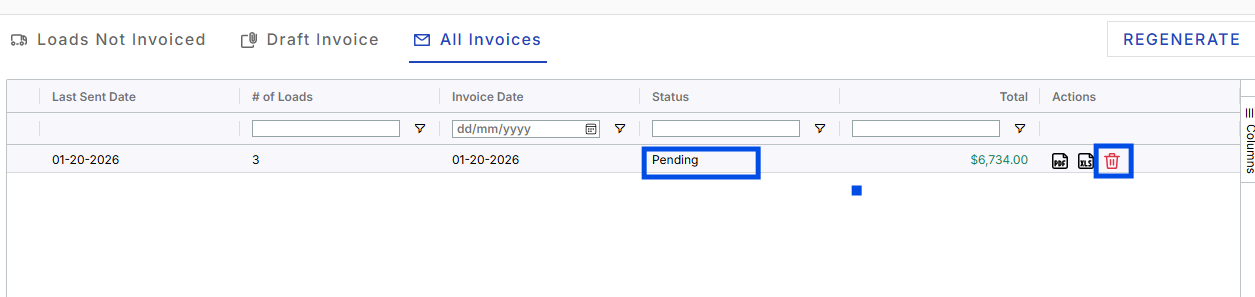 Features the “All Invoices” dashboard ledger with blue boxes highlighting a Pending status and its corresponding trash can action icon.
Features the “All Invoices” dashboard ledger with blue boxes highlighting a Pending status and its corresponding trash can action icon.
Features the “All Invoices” dashboard ledger with blue boxes highlighting a Pending status and its corresponding trash can action icon.
- Navigate to the Loads Not Invoiced tab.
- Select the loads to be included in the new summary invoice.
- Regenerate the summary invoice.
- Verify that the updated summary invoice amount is accurately reflected in QuickBooks Online (QBO).
- Manually delete the old summary invoice from QBO to avoid duplicate records.
Modifying or Adding Charges to Loads within a Summary Invoice
Loads included in a summary invoice can be edited to add charges or make adjustments. Only summary invoices in the following statuses can be regenerated: Pending, Sent, or Partially Paid. If a summary invoice is fully paid, regeneration is not permitted. Steps to Modify or Add Charges to Loads: Confirm that the summary invoice status is not **Paid **in Alvys. If the invoice is marked as Paid, all loads included in the summary invoice are set to Completed, and any subsequent modifications will not sync to QuickBooks Online for completed loads. Navigate to the Load Details page for the specific load included in the summary invoice that requires modification.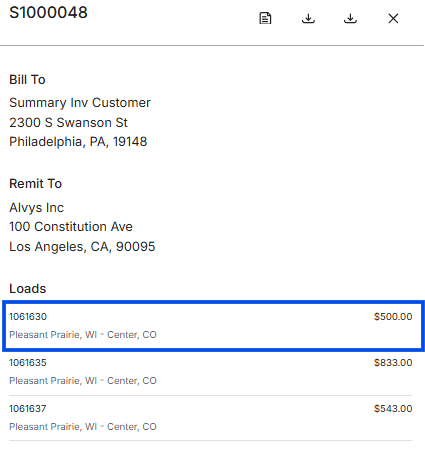 Shows the preview for summary invoice S1000048, with a blue box framing the first load line item (Load 1061630 for $500.00).
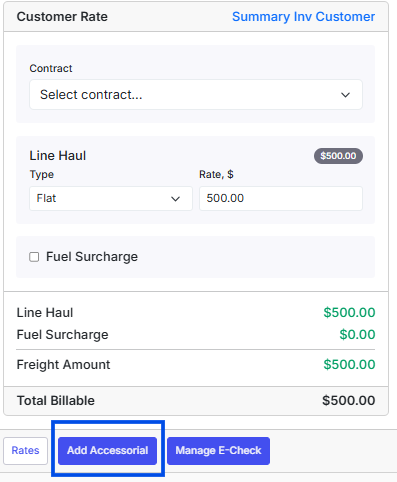 Features a customer rate configuration panel with a blue box highlighting the clickable Add Accessorial button at the bottom.
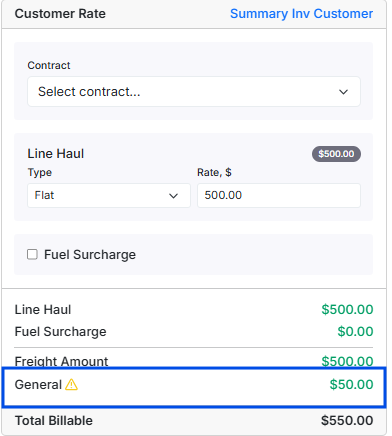 Displays the customer rate panel with a blue box highlighting a newly added General accessorial charge of $50.00 .
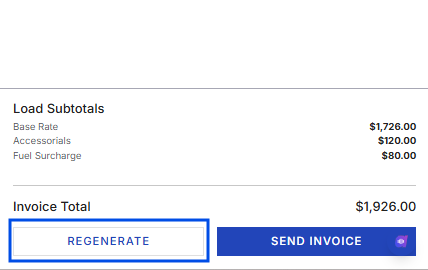 Features a load subtotal breakdown with a blue box highlighting the white REGENERATE action button.